Tuesday, 30 March 2010

Work in progress


video still

Wednesday, 24 March 2010

Fonts


Text/ Font: Things to Come (1936)


Titles from Things to Come (1936), directed by William Cameron Menzies based upon the novel by H.G. Wells.

Tuesday, 23 March 2010

Atypical Route Maquette


As part of out Atypical Route project, G&W will also be creating a text based sculpture to be attached to the railings of the Clyde River bank at Pacific Quay. It is our intention to create a piece that can be viewed from each side of the river. One side will read "Ambition" and the other "Futurity". The text will be created from recycled wooden boards clad with aluminium foil. As a comment on the longevity of current trends of urban revitalisation (particularly visible in this area), it is our intention that these glimmering, optimistic words will quickly loose their veneer with the passing of time.

Ambition: (noun) the desire and determination to achieve success.
Futurity: (noun) the future time / renewed or continuing existence.


Saturday, 20 March 2010

Atypical Route

Atypical Route Poster (design by Ric Warren)

Gallacher & Warren will be presenting work as part of Atypical Route Art Trail, which is an official part of Glasgow International Festival of Visual Art. The project is curated by Nat Lambert and Jamie Cooper and takes place between 16th April & 3rd of May 2010. G&W will be re-installing a new interactive variation of Futureproof (Ambition Modernity & Novelty) that will also include a new video work and be installed in the foyer of Glasgow Science Centre. In addition we shall also be sighting a newly commissioned text-based public sculpture on the banks of the river Clyde at Pacific Quay. Both works will form a response to the urban regeneration of the area and deal with the themes of futurity and utopia.
For more information on this project, please visit the web-site www.atypicalroute.com where more information about our proposal and details of other artists involved can be found.

Friday, 19 March 2010

Cycles of Transformation

video, 06:41" 2009

Friday, 11 December 2009

G&W: FUTUREPROOF (NWSP)

Collective Gallery (Guest Room), Edinburgh, 2009 -in association with PLACE Projects
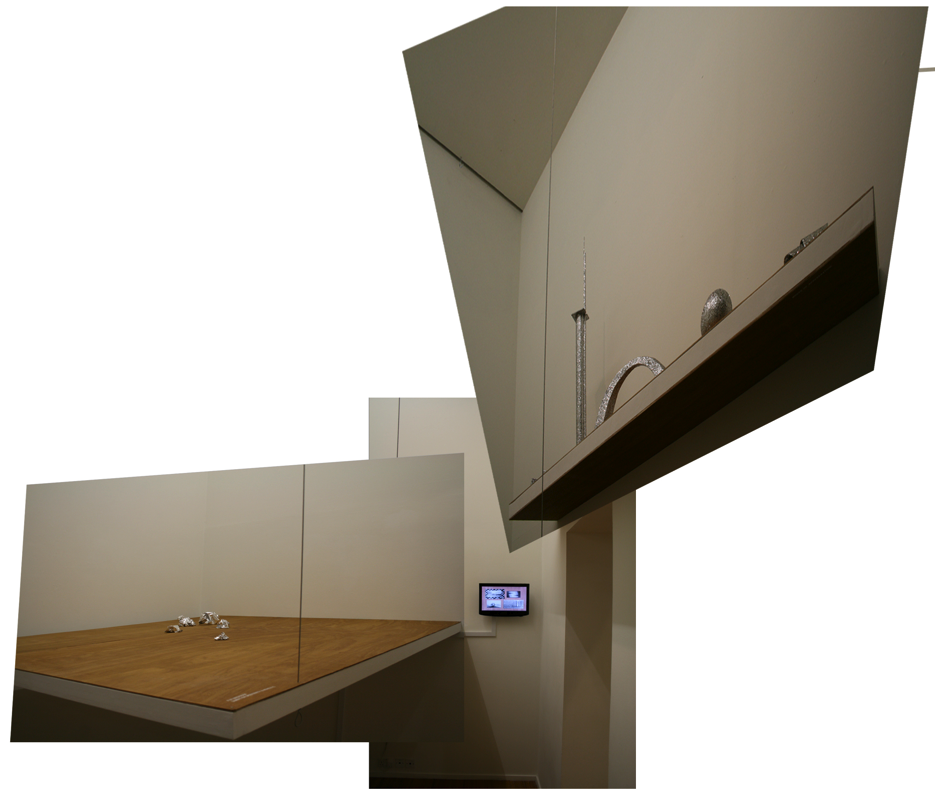
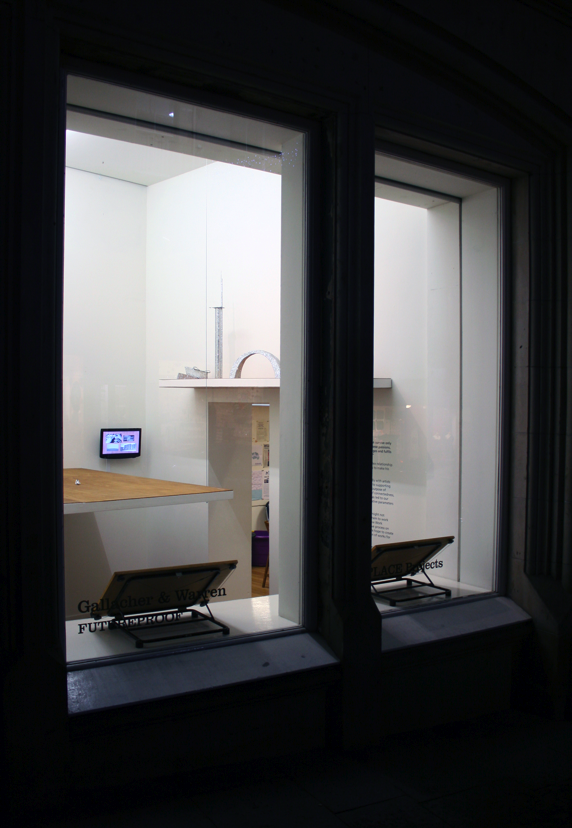
Brought together by the PLACE Projects, Katherine Gallacher and Ric Warren present FUTUREPROOF: an exhibition featuring selected outcomes of a collaborative research project exploring current trends in the revitalisation of urban landscapes. The installation explores various strategies to re-think Edinburgh's historic urban skyline in order to synchronise the city with the new millennium.
Futureproof (Ambition, Modernity & Novelty), 2009 - Detail
Inspired by homogenous approaches to contemporary town planning that employs a process of building glimmering façades of ‘progress’, we created this tongue-in-cheek proposal for a futuristic cityscape. Concerned with the lack of longevity of such regeneration projects we used aluminium foil to create our crudely produced vision of the future. Aluminum foil has an initial aesthetic deception of a resilient glimmering precious metal contrasted with its actual properties as a cheap, flimsy and ephemeral material. This ‘town planner’s table’ attempts to blur the distinction between sculpture and architectural proposal.

Modes of Regeneration, 2009
These glittering models are loosely based on architectural features of Glasgow’s regenerated river Clyde, but are intentionally not direct copies. Instead, they are intended to cross-reference a fashionable vernacular of architecture that is played out across many post-industrial cities. This work is intended to highlight to the homogeny of contemporary urban planning that tends to use tried and tested formulas of urban reform that involve such conscious in-your-face symbols of futurity that can be considered as glittering façades of ‘progress’.
Left to Right: Futureproof (Ambition, Modernity & Novelty) / Cycles of Transformation / Modes of Regeneration, 2009
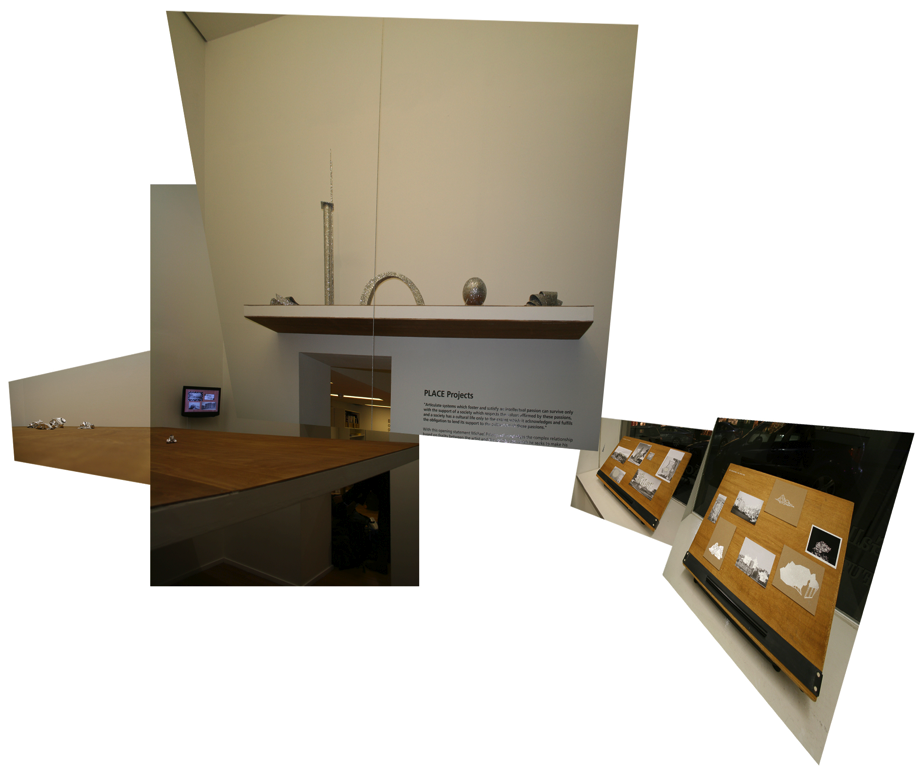
Installation View
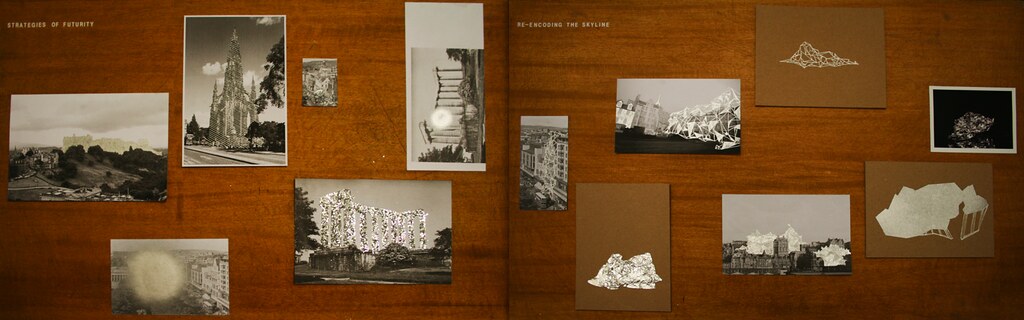
Strategies of Futurity, 2009 &
Re-encoding the Skyline, 2009

"...the image of the city can arise from changes in perception, as well as from physical alterations. The skyline of a city traces the visual signature of its identity. It offers an immediate reading of its ambition, modernity and novelty through which economic, social and aesthetic meanings are signified. Accordingly, urban imaginaries are constituted by visual narratives – summary readings of history and futurity encoded in the skyline, both as its is and how it might be.”

David Parker & Paul Long : ‘The Mistakes of the Past? Visual Narratives of Urban Decline and Regeneration’